# Footprint and labor questions
Square footage is a container, not an operating model. A buyer needs the premises type, customer area, production line, storage, utilities, order channels and local rent convention before a size range becomes an occupancy budget.
Start with Item 7's footnotes. Confirm whether the area is rentable or usable, whether it describes a kiosk, inline unit, end cap, conversion or freestanding restaurant, and whether the range includes seating. Obtain a real landlord proposal and identify base rent, percentage rent, common-area charges, taxes, insurance, utilities and required operating hours. Never multiply a filing's square feet by a remembered market rent and call the result diligence.
The examples here span several models. The 2024 GDK filing used in the comparison set describes a typical 1,200–1,400-square-foot outlet. Shah's Halal describes 1,200–2,000 square feet. Mad for Chicken's 2024 full-restaurant format uses 2,000–4,000 square feet and separately discloses an express format. 375° Chicken 'n Fries uses 800–1,500 square feet. Similar counter-service language can therefore sit on very different real-estate and production assumptions.
Square feet, as filed
## Three formats, three occupancy lines {: .display }
700–1,200Sq ft: compact example
A smaller range can reduce customer area, but storage, utilities, code and order-channel needs still have to fit.
1,200–1,400Sq ft: GDK typical outlet
The typical range in the GDK filing used by this comparison. Verify the current offered format and its seating assumption.
1,200–2,000Sq ft: Shah's Halal assumption
The range in Shah's Halal's 2024 filing. A shared category does not make the premises requirements equivalent.
## Convert a menu into stations
Ask:
- Which stations must be staffed at opening, peak and close?
- Which prep happens before service, and which items are cooked or assembled to order?
- Do counter, kiosk, drive-through and delivery orders enter one queue?
- Who receives inventory, washes equipment, cleans customer space and covers breaks?
- Which roles require a manager or certified food-protection employee?
- Does the Item 7 rent allowance resemble current proposals for the target market and format?
Turn answers into a daypart schedule, including opening prep, overlap, breaks and closing work. Sales per labor hour can be a useful internal ratio only when both terms are defined: which sales, which paid hours, which employees, which period and which stores. A marketing benchmark with no sample or definitions cannot establish staffing for a new outlet. If a franchisor makes a financial performance claim about labor productivity during the sales process, compare it with Item 19 and its substantiation.
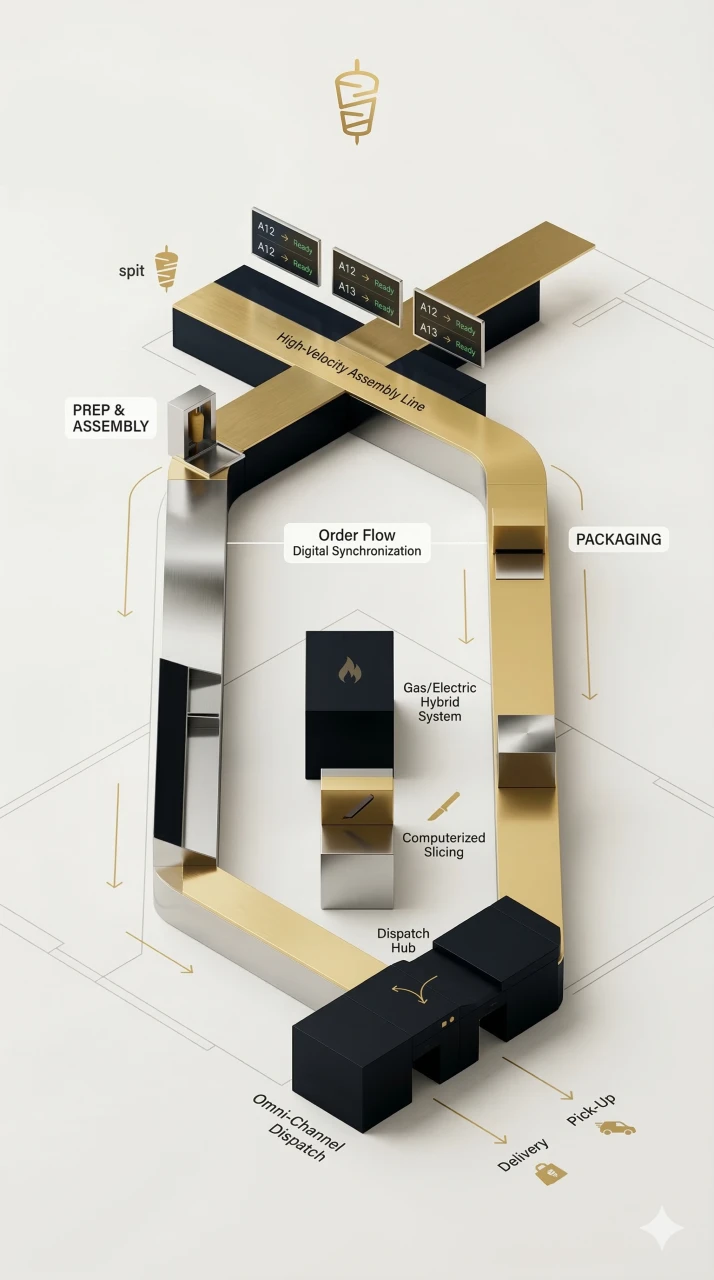
Franchise marketing artwork: a small-format shell drawn apart. It shows an intent, not a filed square footage.
### The drawing is not the disclosure
A shell drawn this tight makes a visual argument for a compact format: a short production line and little customer area.
None of that is a premises commitment. Ask which current format and Item 7 assumptions the drawing represents, then test the answer against a proposed site, code review and equipment utility requirements. Artwork cannot show the storage, access or labor constraints that decide whether a compact box works.
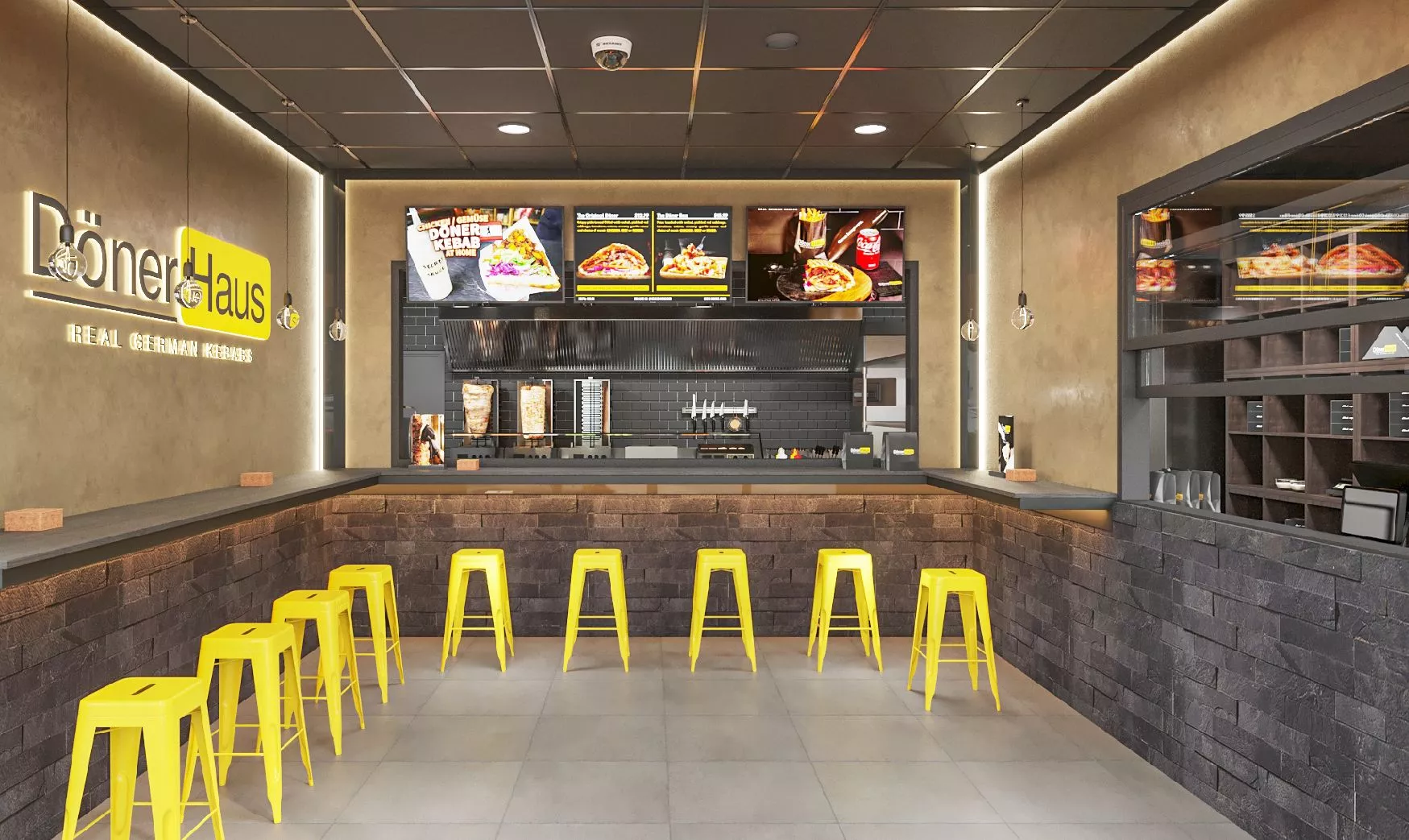
Standing service, so the square footage in Item 7 is line and counter, not seats.
## Compare like with like
Use the current [GDK filing page](https://apps.dfi.wi.gov/apps/FranchiseSearch/details.aspx?id=639752&hash=370187205&search=external&type=GENERAL), the [2025 Shah's Halal document](https://cards.web.commerce.state.mn.us/documents/%7B9078B29B-0000-C21E-982F-C2FDAFB07783%7D/download?contentSequence=0&documentClass=FRANCHISE_REGISTRATIONS) and operator format pages only as dated sources. Wendy's [preferred-site criteria](https://www.wendys.com/real-estate-site-criteria), for example, distinguishes freestanding requirements and lists nontraditional location types. It is useful because it states the format context explicitly, not because its dimensions transfer to another system.
For each candidate site, make one sheet with the offered format, Item 7 area, actual area, seats, channels, operating hours, proposed occupancy charges and a role-by-daypart schedule. Ask several franchisees operating the same format how the opening schedule differed from the stabilized schedule. The result should expose assumptions rather than compress them into a claim that a smaller box always means less labor or a larger box always means better throughput.
## Labor cash in the Item 7 window
Additional funds are the filing's gesture at payroll and occupancy during ramp. They are not a staffing model.
| Brand | Sq ft as filed | Additional funds | Months | Source |
| --- | --- | --- | --- | --- |
| Döner Haus | 700–1,200 | — (not broken out in this dataset) | — | 2026 Franchise Disclosure Document |
| GDK | 1,200–1,400 | $15,000–$20,000 | 3 | FDD issued 3 September 2024 |
| Shah's Halal Food | 1,200–2,000 | $10,000–$30,000 | 3 | FDD issued 10 April 2024 |
| 375° Chicken 'n Fries | 800–1,500 | $30,000–$60,000 | 3 | FDD issued 30 April 2024 |
| The Great Greek Mediterranean Grill | 1,800–2,000 | $35,000–$75,000 | 0–6 | FDD issued 17 August 2023 |
| Mad for Chicken | 2,000–4,000 | $51,375–$162,000 | 3 | FDD issued 3 May 2024 |
A 2,000–4,000 square-foot Korean fried-chicken dining room (Mad for Chicken) and a 700–1,200 square-foot standing imbiss (Döner Haus) are not the same headcount problem. Training hours hint at complexity — Wienerschnitzel 48 classroom + 480 OTJ; Great Greek 60.25 + 180; bluTaco 0 + 11.5 — but hours are not a roster. Build the roster from stations:
- spit or grill;
- assembly / expo;
- cashier or kiosk runner;
- fryer, if the menu needs one;
- dish / smallwares;
- a manager who can close.
If delivery and counter hit the same expo, that is one more body or a longer ticket time. Item 16 (menu) and Item 8 (required equipment) decide whether a station exists. The exploded kitchen drawing on this page does not.
Footprint and labor, one sheet
- Rentable vs usable; seating in or out of the range.
- Landlord proposal vs Item 7 rent/deposit rows.
- Daypart roster, including prep and close.
- Additional-funds row compared with that roster, not treated as sufficient.
- Same-format franchisees asked how opening staffing differed from week twelve.
## Peak is a design load
Item 7 and square-footage ranges are silent on covers per hour. Ask for the prototype's station map and a peak labor chart from operators, not from marketing. A 1,200–1,400 square-foot GDK box (FDD issued 3 September 2024) with a spit, a grill and an expo is a different peak than Shah's 1,200–2,000 chicken-and-rice line (FDD issued 10 April 2024) or Pepper Lunch's teppan service (16 classroom + 192 OTJ in the May 2024 comparative record). Teppan puts cooking in the dining room; labor stands where customers sit. An imbiss puts cooking behind a counter; labor stands where tickets print.
Minimum wage is not in these FDDs as a national figure, so leave it off any cross-brand table. Local wage, scheduling laws and overtime rules belong on the buyer's labor sheet beside the roster. Additional funds of $15,000–$20,000 for three months (GDK) cannot absorb a four-person peak in a high-wage city if sales are slow. That is a sensitivity, labeled as the buyer's, not a correction to Item 7.
375°'s 800–1,500 square feet with $30,000–$60,000 additional funds (FDD issued 30 April 2024) is a smaller box with a thicker cash row than GDK's. Read both. Neither is a staffing certificate. Crave's 15 classroom + 37 OTJ (May 2024 comparative study) is a short program for whatever box that filing assumes — square footage is not in this dataset, so do not guess it from the hours.
The sales-per-labor-hour chart used on the Item 19 page is the anti-pattern: a productivity claim with no sample. If a franchisor quotes a labor ratio in the sales process, it belongs in Item 19 or it belongs in the "unverified claim" log.
Great Greek's 1,800–2,000 square feet and $35,000–$75,000 additional funds over up to six months (FDD issued 17 August 2023) is the seated-dining end of this set: more floor to clean, more hours in the training table, more cash in the ramp row. Döner Haus's 700–1,200 standing imbiss is the other end. Putting both on a "Mediterranean QSR" labor benchmark is a category error. Capriotti's and Wienerschnitzel have no square-footage field here; do not staff them from a neighbor's range.
## Related reading
- [QSR vs fast casual](/qsr-vs-fast-casual/) — labels versus the path
- [What it costs to open](/what-it-costs/) — construction and additional funds
- [Training](/training/) — hours that have to produce the roster
- [Item 8, suppliers](/item-8-suppliers/) — equipment you must buy
- [Item 19](/item-19/) — labor-productivity charts that are not FPRs
---
HTML: https://qsrfieldguide.com/footprint-and-labor-questions/