# Term and territory
A map is not a territory grant. Item 12 must say whether the franchise receives an exclusive territory, how its boundaries are determined, what protection applies and which channels or locations are excluded. Item 17 summarizes the term, renewal, termination, transfer and dispute provisions. The agreement and its exhibits supply the operative language.
## Translate the protection
Copy the boundary exactly: radius, ZIP codes, streets, population, drive time or a bespoke map. Then answer four questions.
1. **Protected from whom?** Other franchisees, company-owned outlets, affiliates or only one of those groups?
2. **Protected from what?** A traditional restaurant, every branded format, delivery, catering, packaged products or online sales?
3. **Subject to what conditions?** Opening deadlines, minimum performance, development schedules or continued compliance?
4. **Excluded where?** Airports, campuses, stadiums, hospitals, military bases, travel plazas, grocery channels or other captive venues?
The [Item 12 rule](https://www.law.cornell.edu/cfr/text/16/436.5) requires disclosure of exclusivity and reserved rights. “Protected” and “exclusive” are not synonyms, and a negotiated area with no minimum size is not the same as a guaranteed radius.
The comparison set demonstrates the range. The 2024 GDK filing describes a non-exclusive protected area negotiated from demographics, with specified venue and delivery carve-outs. Shah's Halal's 2024 filing describes a driving-distance area that can be smaller in cities and excludes non-traditional sites. The Halal Guys' comparative record uses a radius that varies by market. Capriotti's record states no protected area. These are contract structures, not interchangeable descriptions of “a territory.”
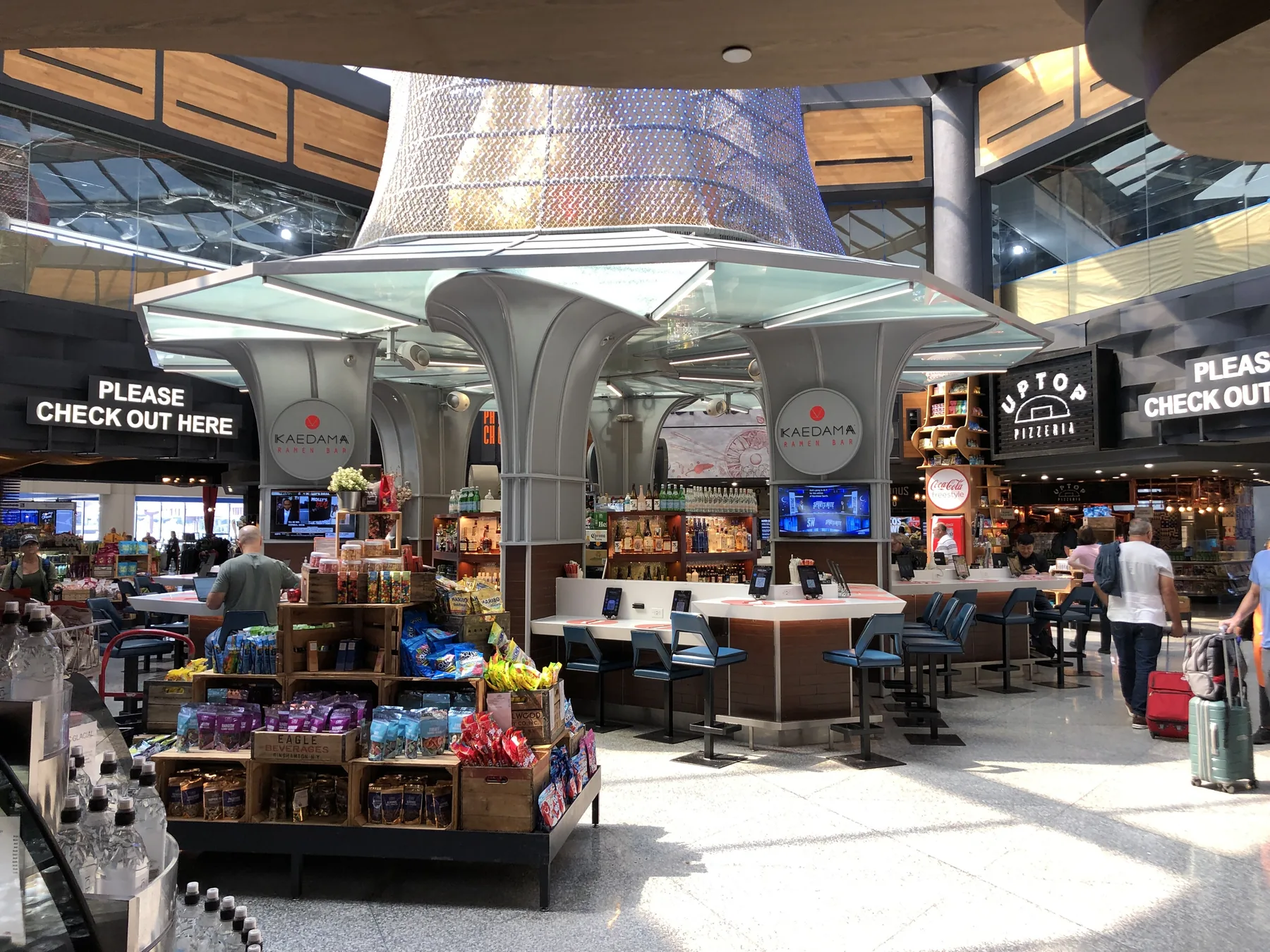
An airport food court is a distinct captive venue, not an ordinary street trade area. A territory clause may reserve locations like this even when nearby streets are protected. Photograph by Famartin, Wikimedia Commons, licensed CC BY-SA 4.0; resized for web display.
Wendy's [official restaurant-design page](https://www.wendys.com/franchising/restaurant-designs) shows why venue carve-outs matter operationally: it treats transportation centers, military bases, food courts and fuel stations as different formats. A buyer should not assume that a street restaurant's area blocks every smaller format bearing the same mark.
## Renewal is usually a new bargain
Move next to Item 17. Record the initial term, any renewal or successor term, conditions, fees, required remodel, release language and whether the franchisee must sign the then-current agreement. The [federal Item 17 form](https://www.law.cornell.edu/cfr/text/16/436.5) specifically requires the summary to explain what “renewal” means, including when materially different terms may apply.
A longer initial term is not automatically better. The brand set includes common ten-year terms, a twenty-year term and a thirty-five-year term. A long term gives more time to recover sunk investment only if the location, economics and adjustment clauses remain workable. It also extends exposure to royalties, required upgrades and operating restrictions.
## Test the exit before the entrance
Read transfer approval, right of first refusal, transfer fees, personal guarantees, death or disability provisions and post-term restrictions. Ask whether the lease term and options align with the franchise term. A ten-year franchise with a five-year lease, or a protected area that disappears on relocation, creates a different risk than either headline suggests.
For each candidate, draw two timelines: franchise agreement and premises lease. Mark opening deadline, development milestones, remodel dates, renewal notice windows and guarantee expiration. Have counsel trace every Item 12 and Item 17 summary to the contract. The practical question is not “Do I have a territory?” It is “Which competition is restricted, for how long, under which conditions, and what happens if this site stops working?”
## Outliers in this set, written plainly
**Wienerschnitzel**, May 2024 comparative study of published FDDs: twenty-year term, **no right of renewal**, **no right to sell**, no protected area. Franchising since 1965, 323 outlets as of 2024. Age and scale do not create an exit the contract withheld. A buyer who needs a transferable asset is in the wrong filing.
**The Great Greek Mediterranean Grill**, FDD issued 17 August 2023: **thirty-five-year** initial term, one additional thirty-five-year term, $2,500 renewal fee. Territory typically a one-mile radius, smaller in dense areas, not exclusive, limited-access venues excluded. Transfer fee the greater of $29,500 or 10% of sale price, capped at the then-current franchise fee. A long term amortizes a $582,014–$1,088,560 Item 7 only if the site, the 6% royalty and the 3% fund (raisable to 4%) remain livable.
**Capriotti's**, May 2024 comparative study: ten-year term, one ten-year option, **no protected area**, 6–7% royalty, brand fund 2% rising to as much as 4%, 1.5% local, 0.65% technology. A transfer is a sale of a site, not of a map.
**GDK**, FDD issued 3 September 2024: ten years; one ten-year option if the outlet is not in the bottom 10% on performance; non-exclusive protected territory with no minimum size; campuses, sports venues, transport sites and aggregator delivery zones excluded. Renewal is a performance gate. Territory is a negotiation, not a guaranteed radius.
**Shah's Halal Food**, FDD issued 10 April 2024: ten years; one additional ten-year term; up to five miles by driving distance, smaller in cities; non-traditional sites excluded. Transfer fee 50% of the then-current franchise fee.
**375° Chicken 'n Fries**, FDD issued 30 April 2024: a specific location rather than an area, sized case by case, not exclusive; two additional ten-year terms.
**bluTaco**, May 2024 comparative study: agreement runs until either party terminates; a one-mile radius or less, set by population. No fixed term to align with a lease option.
**Dog Haus**, same study: half-mile to five-mile radius from demographics, population, income and age; successive ten-year terms; $5,000 renewal fee; $17,500 transfer fee.
Döner Haus has no term or territory field in this dataset. Leave those cells blank.
| Alignment problem | Why it shows up |
| --- | --- |
| 10-year franchise, 5-year lease | You may be a tenant without a franchise, or the reverse |
| 35-year franchise, 10-year lease plus options | Options are not a grant; landlord and franchisor both have to cooperate |
| No protected area plus a "territory" slide | The slide is recruiting; Item 12 is the grant |
| Bottom-decile renewal gate | Ask the definition of performance and the cohort |
| No right to sell | Estate, divorce, and lender conversations change |
Item 12 + 17 in one sitting
- Boundary copied exactly; carve-outs listed.
- Term, renewal conditions, then-current agreement, remodel.
- Transfer right and fee; Wienerschnitzel: write "no sale."
- Lease term drawn on the same page.
- Counsel traces the summary table to clause numbers.
## Delivery, grocery, and the map that stops at the curb
Item 12's reserved rights are where "protected" comes apart. GDK's 2024 filing excludes aggregator delivery zones from the protected description. A customer two streets inside your radius can still be served by another outlet's DoorDash pin if the clause allows it. Capriotti's has no radius to argue about. Shah's driving-distance area, smaller in cities, still excludes non-traditional sites — the airport photograph on this page is the canonical exclusion.
The Halal Guys' May 2024 comparative record uses a quarter-mile to two-mile radius, set by area. That is a market-by-market negotiation dressed as a range. Copy the actual exhibit map, not the range, before you bid a lease. 375°'s specific-location grant, not exclusive, means the protection conversation is really a site-approval conversation.
Renewal notice windows are easy to miss and expensive. If the agreement requires six months' written notice and a remodel bid, put those dates on the lease calendar. Great Greek's 35-year term makes the first remodel more likely to arrive while the original franchisee is still in the building. Wienerschnitzel's lack of renewal makes the last two years of a 20-year term a wind-down, not a sale prep — unless counsel finds a path the comparative record did not summarize. Crave's five-mile radius and one ten-year option (May 2024 comparative study) look "standard" next to those outliers; still copy the radius and the option conditions. Dog Haus's half-mile to five-mile band, set from demographics, is a negotiated map wearing a range. Pepper Lunch's territory "set from demographics and population density," with renewal "as required by the franchisor," leaves two blanks that a buyer should not fill from a sales map.
## Related reading
- [Item 17, renewal and exit](/item-17-renewal-and-exit/) — the summary table at more length
- [FDD vs franchise agreement](/fdd-vs-franchise-agreement/) — exhibits control
- [Single vs multi-unit](/single-vs-multi-unit/) — development area versus unit area
- [QSR vs fast casual](/qsr-vs-fast-casual/) — captive venues as a different format
- [Comparison worksheet](/comparison-worksheet/) — term and territory rows
---
HTML: https://qsrfieldguide.com/term-and-territory/