Items 1–12 42
Item 12, territory
What the grant actually is, what the franchisor reserves, and which channels sit outside the boundary. The rights kept back are usually longer than the rights given.
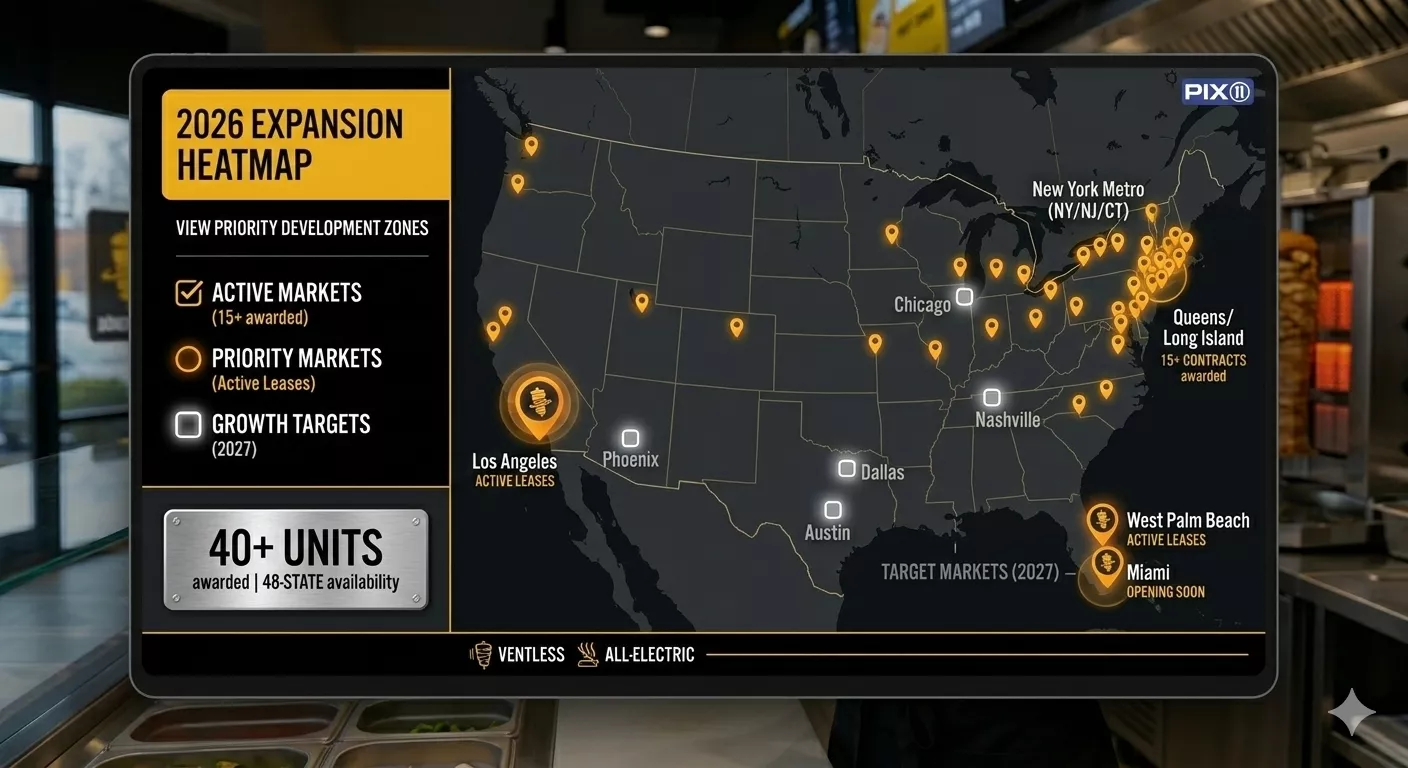
There are two documents describing your territory, and only one of them is enforceable. The first is a map with a shaded circle, produced in a development meeting. The second is Item 12, which has to state whether the franchise receives an exclusive territory, how the boundary is determined, on what conditions the grant continues, and — the part that carries most of the meaning — what rights the franchisor keeps for itself and its affiliates inside and outside that boundary.
This guide already works through territory beside the term on term and territory, where the disclosed boundaries across these filings are compared with renewal and exit. This page stays inside Item 12 itself: its required components, the reserved rights that qualify every grant, and the questions the Item leaves you to ask.
Three components, in order
The boundary. Copy it exactly as written, in the unit the filing uses. These filings show how little those units have in common. Crave’s May 2024 comparative record uses a flat five-mile radius. Dog Haus’s, in the same study, runs from half a mile to five miles, set from demographics, population, income and age. The Halal Guys’ runs a quarter-mile to two miles by area. Mad for Chicken’s FDD issued 12 March 2025 describes a minimum five-mile radius in the suburbs and a quarter-mile in a city, sized after the site is approved. Doner Shack’s FDD issued 29 April 2025 sets no minimum size at all and draws the boundary case by case from the target demographic, describing it by zip codes, streets or landmarks. bluTaco’s is a mile or less, set by population. 375° Chicken ‘n Fries’s FDD issued 30 April 2024 grants a specific location rather than an area at all. Pepper Lunch’s record describes a territory set from demographics and population density, with no figure attached.
A range is not a grant. Where a filing describes a band, the number that binds is the one written into the exhibit map when the site is approved, which is usually after the buyer has already signed. Ask when the boundary becomes fixed and what happens if the approved site produces a smaller area than the range implied.
The conditions. Almost every grant is conditional. Opening deadlines, minimum performance, development schedules and continued compliance are the usual triggers, and a territory that can be reduced or removed for underperformance is a different asset from one that cannot. This is where Item 12 and Item 17 meet: GDK’s FDD issued 3 September 2024 conditions its single ten-year renewal option on the outlet not being in the bottom ten per cent on performance, which is a numeric gate on the relationship as a whole and a fair guide to how the same document thinks about protection.
The reserved rights. This is the paragraph that decides whether the first two mattered. It states what the franchisor and its affiliates may do inside your area: operate company outlets, franchise other outlets, sell through other channels, use alternative formats, and place units in captive venues. GDK’s territory is described as non-exclusive with no minimum size, and excludes campuses, sports venues, transport sites and aggregator delivery zones. Shah’s FDD issued 10 April 2024 excludes non-traditional sites from a driving-distance area. Great Greek’s excludes limited-access venues. Capriotti’s May 2024 record discloses no protected area at all, which at least has the virtue of being unambiguous.
Channels are the modern boundary
A radius was a good description of a restaurant’s trade area when customers arrived on foot or by car. It describes very little about a delivery order routed by an aggregator, a catering order placed by a company two towns away, a packaged product sold in a grocery chain, or a virtual brand operating out of somebody else’s kitchen.
Item 12 has to address whether the franchisor may use other channels of distribution, and whether the franchisee may. Both directions matter. If the franchisor reserves online and delivery sales, another outlet’s pin can serve a customer who lives inside your circle. If the franchisee is restricted from catering or from operating a delivery-only format, a route to revenue that the site could support is closed. Dog Haus’s May 2024 record discloses a ghost-kitchen format with a 4% royalty against 6% for a restaurant, and Mad for Chicken discloses an express format at $243,500–$470,700 beside its full restaurant. Where a system has more than one format, ask which of them your territory excludes, because a smaller sibling format is often exactly what a reserved right permits nearby.
Before you leave Item 12
- Copy the boundary verbatim, with its unit, and note when it becomes fixed.
- List every condition that can shrink or end the grant.
- List every reserved right, for the franchisor and for affiliates, separately.
- Write down which channels are excluded: delivery, online, catering, grocery, wholesale.
- Ask which other formats the system operates and whether they are excluded from the grant.
- Read the answers beside Item 17’s renewal, relocation and transfer rows.
What the Item does not promise
Item 12 is not a promise of customers, and it is not a market study. A large radius in a thin trade area is worth less than a small one in a dense one, and the filing makes no claim either way. Nor is a territory a promise of exclusivity against competitors: it restrains the franchisor and the system, not the street.
It is also not a guarantee of continuity through the term. Relocation provisions, condemnation or lease loss, and the treatment of the area on renewal are typically dealt with in the agreement rather than in the Item 12 summary, and they decide whether the protection survives the events most likely to happen to a restaurant over ten years.
Finally, a development pipeline map is not this Item. A slide showing markets available and units wanted is a recruitment document. Item 20’s projected openings, where disclosed, are the closest thing in the FDD to a forward statement about where the system is going, and even those are plans measured against last year’s actual openings.
Taking it to the franchisor
Ask for the exhibit map used at the last three openings in comparable markets, not a sample. Ask how many outlets, of any format, the system has placed within the disclosed radius of an existing unit in the last two years. Ask whether delivery-platform territories are administered by the franchisor and how order routing between two nearby stores works in practice. Ask what happens to the territory if the site is lost and a replacement is approved a mile away.
An evasive answer to the delivery question is the one to note. It is the reserved right most likely to be exercised, the hardest to see from outside, and the least likely to have been discussed in the meeting where the shaded circle was drawn.
Related reading
- Term and territory — the disclosed boundaries beside the terms
- Item 17, renewal and exit — the conditions that end a grant
- Item 16, what you may sell — restrictions running the other way
- Single vs multi-unit — a development area is not a unit territory
- Red flags in franchise marketing — maps that are not disclosures
Asked in the field
- What is the difference between protected and exclusive?
- Exclusive means the franchisor has kept nothing back inside the area. Protected usually means it has kept something back and told you what. The reserved-rights paragraph is where you find out which word applies.
- Does a territory cover delivery?
- Only if the Item says so. Delivery, catering, online ordering and third-party marketplaces are separate channels and are frequently reserved.