Process 27
Single vs multi-unit
Döner Haus sells one compact shop. GDK's 2024 filing does not offer a standalone store — five-outlet minimum. A unit franchise and an area agreement are different contracts.
Sales language blurs “buy a franchise,” “take a territory,” and “become the developer for the metro.” Those are different pieces of paper. Item 5 and Item 7 usually describe one unit. The development or area agreement — listed in Item 22 — describes the rest.
This site records one disclosed multi-unit structure with a number attached: GDK’s FDD issued 3 September 2024. The Item 7 range of $690,500–$1,123,000 is per outlet inside a five-outlet minimum; a standalone single-store purchase is not offered. Döner Haus’s 2026 filing describes one compact shop. Those are not the same purchase. Other brands may sell development deals in the current year. If that schedule is not in the filing in front of you, it is not printed here.
Three legal shapes
Single-unit franchise. One site, one franchise agreement, one Item 7 table. Territory, if any, is the Item 12 grant for that unit. Capriotti’s May 2024 comparative record states no protected area, so “single-unit” there is a site, not a map. 375° Chicken ‘n Fries’s FDD issued 30 April 2024 describes a specific location rather than an area, sized case by case, not exclusive.
Area development (or multi-unit commitment). A schedule of additional outlets, usually with a development fee, opening deadlines, and a consequence for missing them — loss of exclusivity, loss of the remaining schedule, default. Item 7 may still be printed per restaurant. Multiply only after you have read whether fees are due up front or as each unit is signed.
Area representative / master. A different offering: recruiting and supporting franchisees rather than operating restaurants. Atomic Wings is absent from this site’s Item 7 worksheets because the filing on hand is an Area Representative FDD — a laptop, a vehicle and a home office, not a restaurant build-out. If someone hands you an area-rep Item 7 and calls it a restaurant, they have described the wrong business.
The Halal Guys’ official franchise page discusses single- and multi-unit buyers. That page is recruiting language. The 2025 Wisconsin filing is the document that lists the contracts. Do not take a website’s “multi-unit” headline as a disclosed schedule.
A worked GDK file
Write this on the comparison sheet exactly as disclosed, source FDD issued 3 September 2024:
- Offering shape: five-outlet minimum; no standalone single-store purchase.
- Per-outlet Item 7: $690,500–$1,123,000 for a typical 1,200–1,400 square-foot outlet.
- Per-outlet Item 5: $30,000 initial franchise fee.
- Additional funds: $15,000–$20,000 for about three months, per the Item 7 table.
- Term: 10 years; one ten-year renewal option if the outlet is not in the bottom 10% on performance.
- Territory: non-exclusive protected territory, no minimum size, negotiated from demographics; campuses, sports venues, transport sites and aggregator delivery zones excluded.
Then do the arithmetic the filing will not do for you: five times the per-outlet fee is $150,000 of Item 5 if each unit pays $30,000 — unless the development agreement charges something else. Five times the Item 7 high is more than $5.6 million of estimated investment if you naively multiply the high column. That product is a sensitivity, not a disclosed total. The filing did not print a five-store Item 7. A lender who underwrites “the first store” against a contract that defaults the whole schedule is underwriting the wrong project.
Item 1 of that same GDK filing claimed nine outlets open by issuance, against seven at year-end 2023. A five-store developer walking into a young US system should ask how support, supply and field visits scale when several of those five open in the same year.
What else changes the unit-count question
Shah’s Halal Food, FDD issued 10 April 2024: 58 outlets, 14 company, 0 franchised, 44 licensed. Buying “the brand” as a franchise is not buying a 58-unit playbook. It is buying an offering that, at that year-end, had no operating franchises.
Pepper Lunch, May 2024 comparative study: 6 US units, all franchised. The brand’s own site claims over 500 locations across fifteen countries. A US multi-unit pitch that leans on the international count is mixing populations.
375° Chicken ‘n Fries, FDD issued 30 April 2024: 5 total, 2 franchised as of 2023. A three-store development would be large relative to the disclosed system.
Wienerschnitzel, May 2024 comparative study: 323 total outlets, 246 franchised, 77 company. A large system can support multi-unit operators as a practical matter. It also discloses no right of renewal and no right to sell. Scale does not invent an exit.
The Great Greek Mediterranean Grill, FDD issued 17 August 2023: 31 total, 24 franchised, 7 company; thirty-five-year term. A long unit term is not a development schedule. Do not infer a required store count from the length of the contract.
Mad for Chicken, FDD issued 12 March 2025: a full restaurant Item 7, a separately disclosed express format at $243,500–$470,700, and a Multi-Unit Development Agreement at $263,500–$711,700. Only the first two are boxes. The third is entry into a three-outlet development agreement plus the first outlet, at a $55,000 development fee against the single-unit $35,000, with its low assuming an Express Model and its high assuming a Full Restaurant — so it is the multi-unit sheet on this page, and it still prices one restaurant. A “multi-unit” conversation that mixes those tables without labeling them is three offerings pretending to be one.
Doner Shack, FDD issued 29 April 2025: $498,000–$1,007,000 for a single restaurant and $578,000–$1,087,000 for a three-restaurant development agreement. The development figure is not three times the single-unit figure, so read what the second table actually covers before assuming the rest is priced later.
Unit deal or area deal
- Name the contract: unit franchise, development agreement, area rep — from Item 22, not from the call.
- Copy the required store count and the first missed-date consequence.
- Keep per-unit Item 7 and the development fee on separate lines.
- Match territory language: unit radius, development area, or no protected area (Capriotti’s here).
- Ask how many of the required stores can actually be staffed and trained in the disclosed Item 11 window.
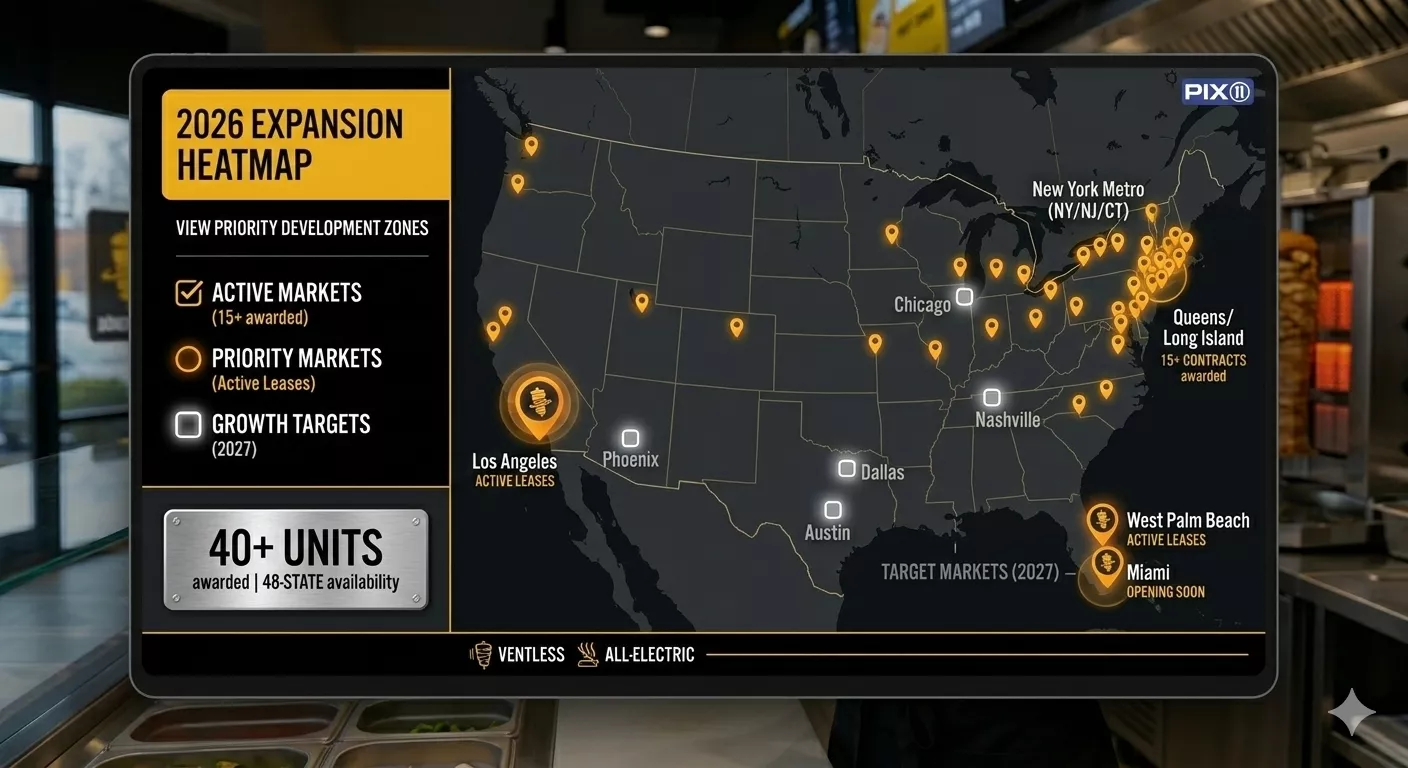
- Do not fill a blank development schedule with GDK’s five or with a heatmap’s “units wanted.”
Related reading
- Timeline to open — one store’s path, then the second deadline
- Qualification — liquidity for one box versus a schedule
- Financing overview — lenders underwrite the contract you sign
- Item 12 and term — area versus site
- Item 20 outlet tables — whether the system has ever opened stores at the pace being discussed
Asked in the field
- Is a multi-unit deal just several copies of Item 7?
- No. Development fees, opening dates, forfeitures and lost area live in a separate agreement.
- Does every brand here sell single units?
- No. Döner Haus's 2026 filing is one compact shop. GDK's 2024 filing does not offer a standalone single-store purchase.