Read 10
Red flags in franchise marketing
GDK cannot count its own shops. Shah's locator is mostly licensed. The high column does not add. And the company at the back of the packet may be losing millions a year.
A franchise deck is a sales document. An FDD is the document a regulator will read. When they disagree, believe the FDD.
The flags below are in the filings. A young brand with a thin Item 19 is one kind of risk. A young brand with a thin Item 19, a five-store minimum, uncapped fees and six years of losses is another.
GDK cannot count its own shops
Item 1 of German Doner Kebab’s FDD issued 3 September 2024 said nine outlets were open by issuance. Item 20 of the same document said seven at year-end 2023. Both numbers are in the packet they handed you. Treat either one as “the system” and you have invented a count the filing itself will not stand behind.
The subsequent-events note in that same filing then named Bay Ridge and Brighton Beach as 2024 openings and Columbus Park as already closed. By August 2026 the public listings for Sugar Land, Bay Ridge, Westfield and Brighton Beach read permanently closed. Item 20 through 2023 recorded zero cessations. The shops added as openings are among the ones now gone. A locator is not a survival record.
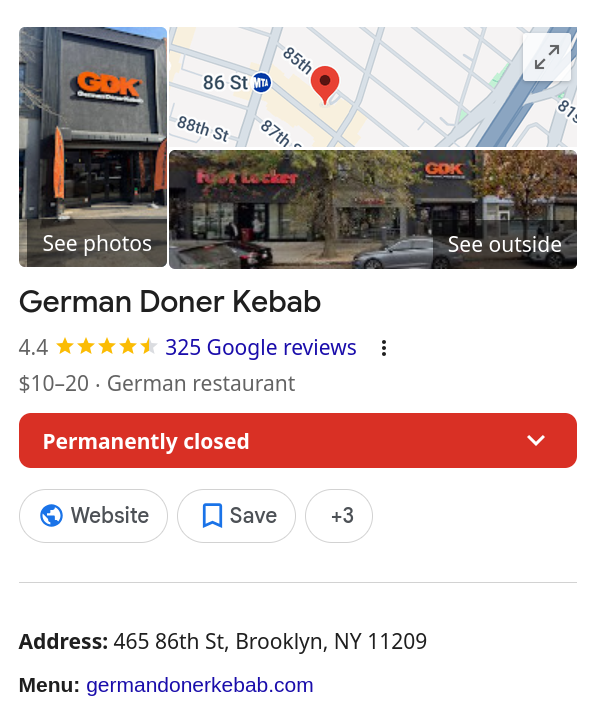
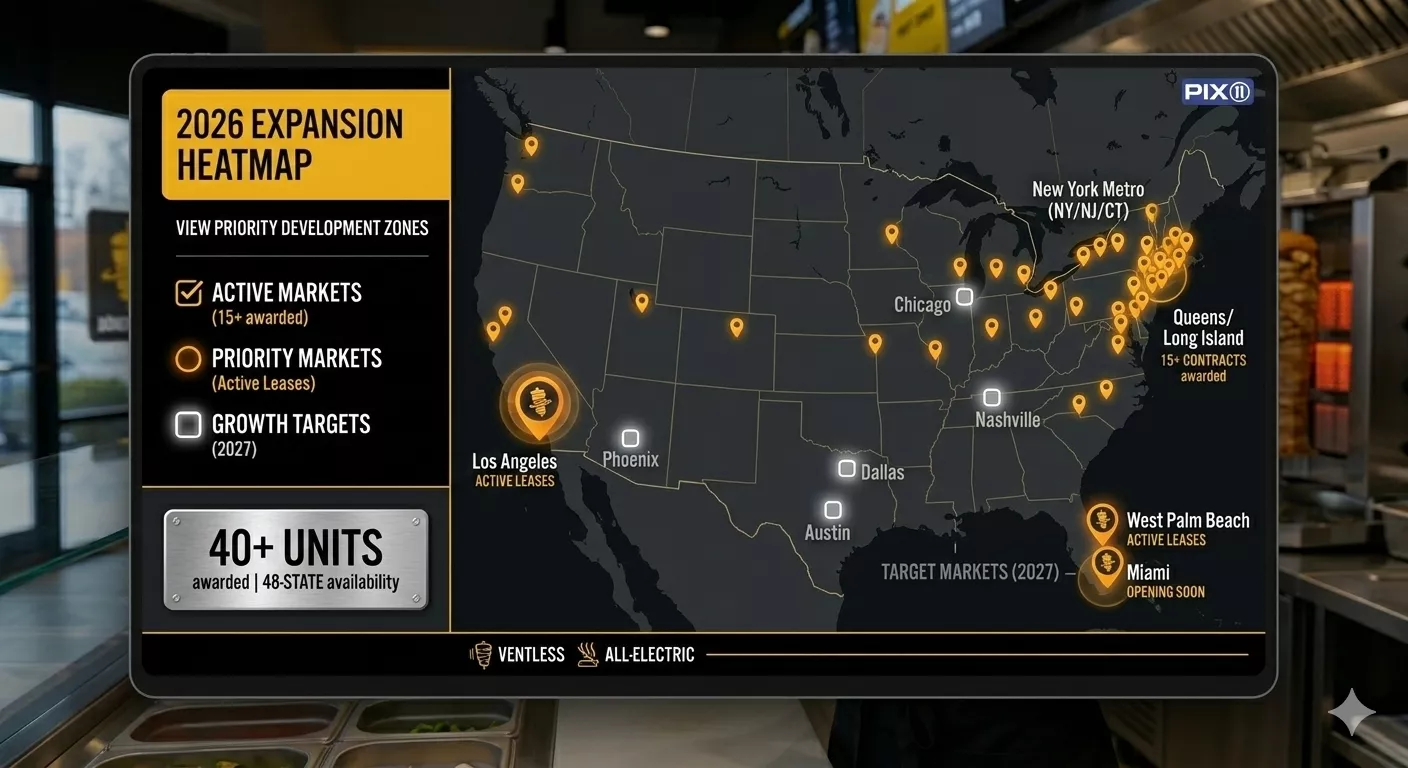
Signed deals, “in development” pins and a heatmap of units wanted are pipeline. Item 20 is openings, transfers and closures.
Shah’s locator is mostly licensed
Shah’s FDD issued 10 April 2024: zero franchised outlets, forty-four licensed of fifty-eight. The locator looks like a chain. Item 20 looks like a licensing business that has started to sell franchises. Call a licensed operator to “validate” the franchise and you are asking the wrong person about the wrong contract.
Pepper Lunch does the international version of the same mismatch. The May 2024 comparative record has six US units. The operator site claims 500+ across fifteen countries. The American offering is the American filing. The overseas estate is someone else’s.
Doner Shack, FDD issued 29 April 2025, shows the same mismatch in a döner shop: zero US outlets in 2022, 2023 and 2024, three affiliate restaurants and four franchises in development in the United Kingdom. UK shops do not fill US Item 20. As of 2026 the brand is not selling US franchises. A signed Prosper, Texas facade is unpublished as open. India master deals sit on the same franchise site that paused US enquiries.
The column that does not add
Shah’s printed high is $405,000. Add the line items and the column comes to $410,000. That gap is in the document. Do not “correct” it for them, and do not average it away. A filing that cannot add its own estimate is telling you how carefully the rest of it was made.
375° Chicken ‘n Fries, FDD issued 30 April 2024, prints a royalty as “five percent (6%)”. The Item 6 table says 6%, so that is the rate used here. The franchise agreement is the page that has to pick one.
Great Greek’s 17 August 2023 low end uses a discounted fee for people who already own an affiliated brand. Quote that low to a first-time buyer and you have described a deal they cannot have.
Fees that can go up forever
GDK’s 2024 filing lets the royalty and the brand fund rise every year with no cap. The current 11% stack — 6% royalty, 3% brand fund, 2% local — is the starting rate. Model that rate, then model the clause that lets them raise it.
bluTaco’s Item 6 in the May 2024 comparative record does not disclose a royalty. Leave the cell blank. Do not rank a blank as 0%, and do not sort it as the lowest stack in the fee table.
A margin slide with nowhere to live
Shah’s and The Halal Guys, in the 2024 sources, make no financial performance representation. A deck that then shows a unit margin is a claim with no Item 19 home. The FTC’s buyer guidance is blunt about this: sales and earnings talk from a franchise seller belongs in Item 19, with narrow exceptions. If nobody can point to a page of Item 19, the slide is marketing.
“Street food,” “kiosk” and “fast casual” are claims about the room. Compare them with Item 7’s premises, square footage, seating and construction. A larger box means different rent and a different labor chart.
You do not own this
Wienerschnitzel, in the May 2024 comparative study: no renewal, no right to sell. A pitch about buying a business cannot survive Item 17 if Item 17 says you cannot leave and cannot transfer. Ask a lender what collateral that is.
Capriotti’s, same study: no protected area. A shaded map in the deck is decoration. Another unit nearby is what the grant allows.
Renewal described as “an extension” still has to be read in Item 17: the remodel, the release, the fee and the then-current contract. The summary does not replace the clause.
Company artwork
How Döner Haus draws the category
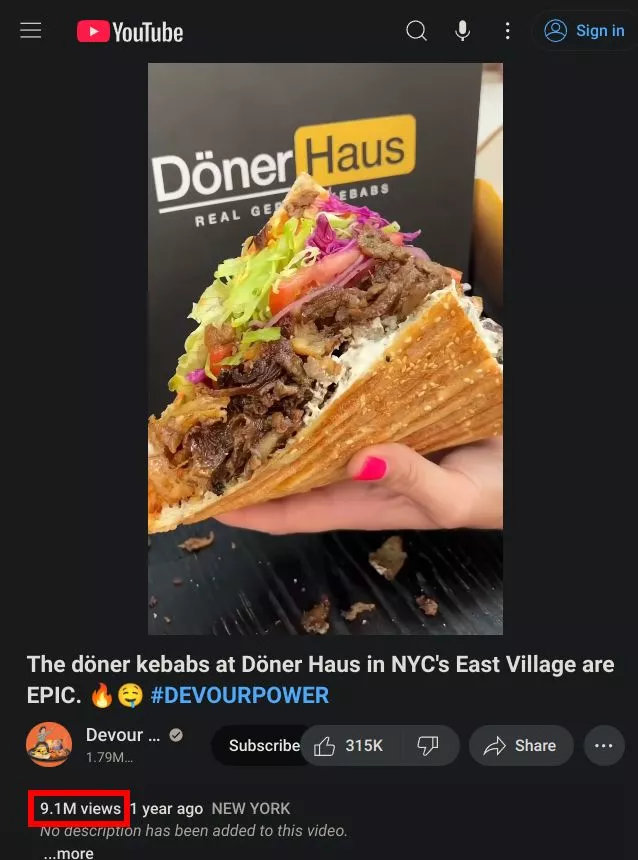
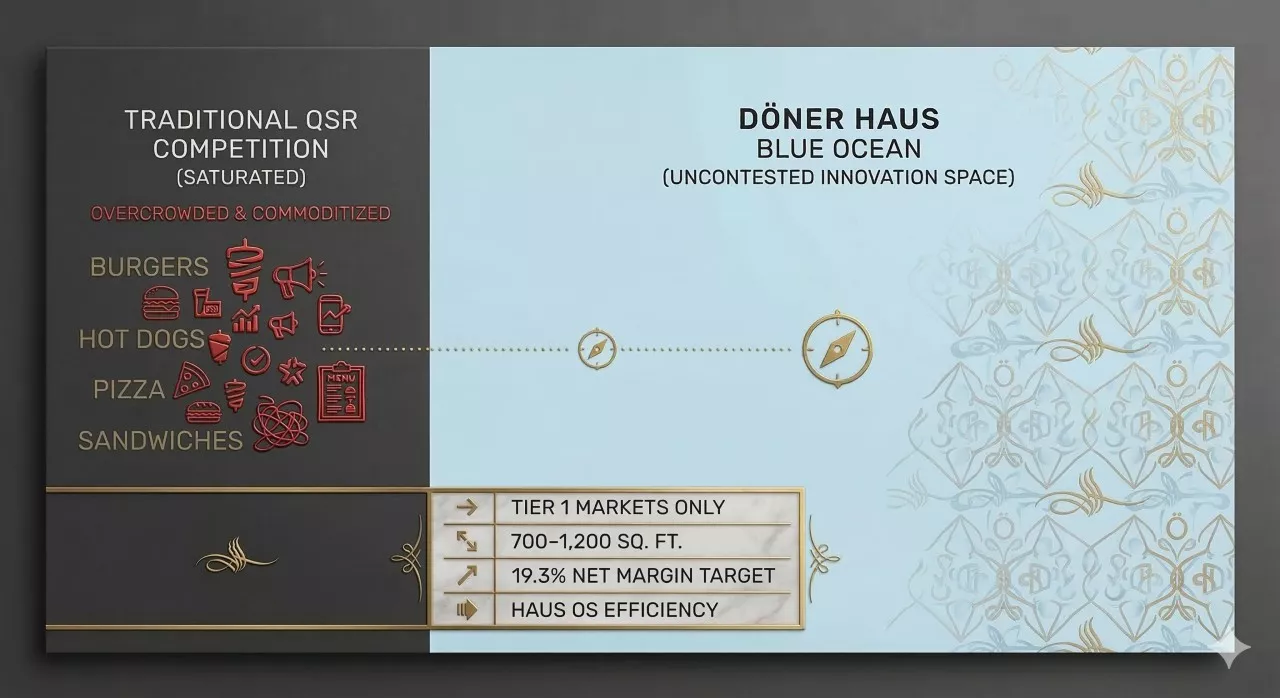
Three graphics from the Döner Haus franchise pack. They show how the company presents the sandwich, the US QSR field, and its development plan.
The company behind the promise may be losing millions
Every obligation in Items 11, 12 and 13 — training, a defended mark, a supply chain — is a promise from a company that has to stay solvent to keep it. That company lives in Item 21, an exhibit at the back in a different typeface. Skipping it is how people buy a support office that cannot pay for itself.
GDK has never made a profit. Six years on file, six losses, about $7.47 million. The accumulated deficit at 31 December 2024 is $7,609,195. Almost nothing has been earned back. The company told its auditor it expects to keep losing money until enough franchise stores are open, and that it pays its bills because the ownership group keeps advancing working capital: $3.4 million, then $4.8 million, then $5.9 million at the 2022, 2023 and 2024 year ends, plus another $1.5 million after year end (FDD registered 24 September 2025). If those advances stop, the franchisee has no claim on them. The auditor issued an unmodified opinion and added an “Emphasis of Matter” that describes the losses, the expected further losses, and the owner advances. GDK has never covered its own costs. Operations continue because owners keep advancing cash they are free to stop advancing. That is the company that would owe you training, a mark and a supply chain for ten years.
Atomic Wings carried a going-concern warning, then later filings dropped it. The FDD issued 30 April 2024 carries a cover-page special risk: the auditor “expresses substantial doubt about the franchisor’s ability to remain in business.” Loss from operations of $205,812.35 in 2022. The FDD issued 29 April 2025 reports net income of $22,170.92 for 2023 and $110,756 for 2024, and the going-concern paragraph is gone. A softer financial-condition risk stays on the cover as item 3. Cover-page special risks can come off when later results change the picture. That is what happened here.
Capriotti’s lost far more, without a cover-page special risk. $4,368,938 in the year ended 25 December 2022, accumulated deficit $23,777,352, unmodified report, no extra paragraph (FDD issued 21 July 2023). Auditors look at whether the company can continue, and on what funding, not at ranking the dollar size of a loss. Atomic Wings’ 2022 operating loss was $205,812.35; Capriotti’s 2022 loss was more than twenty times that. Only Atomic Wings had the going-concern language on the cover, so that is the one the state made you read first.
An equity section headed “Members’ Deficit” has to be read against the years behind it. Dog Haus reported $2,344,415 of profit in FY2023, the highest figure among the Item 21 packets on the comparison table, and the statements are still headed “Members’ Deficit”. The Halal Guys was profitable in all three disclosed years while an accumulated deficit shrank from $(3,693,003) to $(371,445). Great Greek’s three years to 30 April 2023 lost $3,915,565, largely to litigation rather than restaurant operations. Doner Shack has one audited year, a $90,719 loss. Döner Haus’s 2026 filing covers a stub year from formation plus FY2025; the opinion is unmodified. Pepper Lunch and Wienerschnitzel have no statements on hand here, so their Item 21 cannot be compared.
GDK’s own 2025 filing shows the hole getting deeper inside the same document: audited deficit $7,609,195 at 31 December 2024, unaudited interim $7,923,332 at 31 July 2025, on $826,507 of revenue. Seven more months, another $314,000 of deficit, still not profitable.
Several flags at once
GDK’s 2024 filing combines a young US count, a five-outlet minimum, and fees with no ceiling: seven units at year-end 2023, Item 7 per store inside a five-store commitment, royalty and fund raisable without a cap. Together they are a development schedule, a support schedule and a cost schedule pointing at a company that has never covered its own costs. The shops that filing named as 2024 openings in Bay Ridge and Brighton Beach are now marked permanently closed. Sugar Land and Westfield are too.
Shah’s 2024 filing combines a licensed street presence, zero franchises, and no Item 19. Licensed shops can prove the food without proving the franchise contract, because that packet does not yet show one operating.
Wienerschnitzel’s 2024 comparative record is 323 units and no exit. Capriotti’s is 145 units, no protected area, a brand fund that can go to 4%, and a technology percentage. Pepper Lunch is six American shops in front of a 500-shop website. bluTaco is a missing royalty, a missing Item 7, 11.5 training hours and an at-will term. Leave those blanks on the worksheet.
A stale FDD is easy to miss. Compare the legal entity, the issue date and the state filing — GDK’s 2025 Wisconsin filing and The Halal Guys’ 2025 filing are the public check — against the PDF in the email. An aggregator copy is research. The document they deliver is the one the fourteen-day clock runs on.
If they cannot put the deck and the current FDD on the same page, stop. The filing is what you would be signing.
Related reading
- Item 19 — where performance claims belong
- Item 20 outlet tables — locators versus movement
- Item 21, financials — the franchisor’s own audited results
- The auditor’s report — what the headings actually mean
- Ongoing fees — caps, and the rate that is missing
- Discovery day — decks in a darkened room
- Franchisor question list — the written version of “which page is that”