Read 06
System size
Item 20 is a three-year movement schedule, not just an ending outlet count.
Item 20 shows how a franchise system changed over the last three fiscal years. The first table is a systemwide summary of franchised and company-owned outlets; later tables break out transfers, openings, terminations, non-renewals, reacquisitions and closures by state. The federal disclosure rule specifies those categories and requires contact information for current and certain former franchisees.
Add the rows yourself
Do not copy only the final total. For each year, start with outlets at the beginning, apply the disclosed movements and land on the ending count. Keep ownership changes separate from physical openings and closings:
- A transfer usually means the outlet stayed open but changed franchisee.
- A reacquisition moves an outlet from franchised to company ownership.
- A termination, non-renewal or ceased operation may remove a franchised outlet for different contractual or economic reasons.
- A company opening adds a unit but does not show franchisee demand.
Definitions and table relationships matter. If the arithmetic does not land, check footnotes, amended pages and whether the same outlet moved through more than one status during the year. The footnote is the next sentence — not a spreadsheet “fix.”
Size is context, not a grade
The brand set ranges from mature systems to early franchise programs. The 2024 comparative records used here show Wienerschnitzel at 323 total outlets, Capriotti’s at 145 and Pepper Lunch at six US outlets. Shah’s Halal presents a different complication: its 2024 filing described many operating locations under license arrangements while reporting no operating franchises at the relevant year end. A consumer locator and an Item 20 franchise count can therefore both be accurate while answering different questions.
Young systems can offer direct access to founders and undeveloped markets, but a small comparable population makes support, purchasing, closures and Item 19 results harder to evaluate. Large systems offer more calls and operating history, but size does not prove attractive economics or good franchisee relations. Scale is evidence about sample size and organizational demands, not quality.
Use date labels every time. GDK’s 2025 Wisconsin filing page identifies a document effective in September 2025; The Halal Guys’ 2025 Wisconsin filing was effective in May 2025. Their Item 20 tables close on fiscal year-end dates before those filing dates. A location page viewed today is not a same-day comparison with either table.
Read beyond the count
Calculate simple movement measures, but label them carefully: openings as a share of beginning outlets, ceased operations as a share of beginning franchised outlets and transfers as a share of the franchised base. Do not collapse every departure into “failure.” A transfer may be healthy succession or distress; a reacquisition may be strategic or a rescue.
Then call people. The FTC recommends using the Item 20 lists rather than relying only on contacts selected by a seller. Choose current franchisees across opening years and performance contexts, plus former franchisees from the disclosed list. Ask what caused transfers or exits, how support changed with system growth and whether planned openings arrived on schedule.
Finally, compare development obligations with actual openings. A pipeline, signed agreement or “units wanted” map is not an outlet. Item 20 records what opened and what happened afterward. That is why it belongs beside Item 19 and Item 21: store movement, unit performance and franchisor financial capacity describe different parts of the same system.
Populations that are easy to miscount
Licensed shops. Shah’s Halal Food, FDD issued 10 April 2024: 58 total, 14 company, 0 franchised, 44 licensed. Item 20 stated that no franchises were operating as of the filing. A 58-pin locator and a zero-franchise table can both be right. Validation calls to licensees are a different legal relationship.
International websites. Pepper Lunch, May 2024 comparative study: 6 US units, 0 company, 6 franchised. The brand’s site claims over 500 locations across fifteen countries. Put the international claim in a note. Put 6 in the US Item 20 cell.
Narrative vs table. GDK, FDD issued 3 September 2024: 7 units at year-end 2023, all franchised; Item 1 claimed nine open by issuance. Ask which two opened, in what format, and whether they had a full year for Item 19 (that Item used one mall unit).
Affiliate-heavy young systems. Mad for Chicken, FDD issued 12 March 2025: 12 total, 10 company, 2 franchised. 375° Chicken ‘n Fries, FDD issued 30 April 2024: 5 total, 3 company, 2 franchised. Item 19 samples in both filings lean corporate/affiliate. Item 20 is how you see that before you model.
The large end. Wienerschnitzel 323 (246 franchised, 77 company); Capriotti’s 145 (135 / 10); The Halal Guys 93 (88 / 5) — May 2024 comparative study, counts as of 2024. Enough contacts for a real sample. Still rebuild the movement. Wienerschnitzel’s size does not add a right to renew or sell; that filing discloses neither.
A 2025 document with an empty US table. Doner Shack, FDD issued 29 April 2025: zero franchised and zero company-owned US outlets at the start and end of 2022, 2023 and 2024, from a franchisor that began offering US franchises on 5 September 2024. The affiliates run three restaurants in the United Kingdom with four more UK franchises in development. There is no US movement to add up. As of 2026 the brand is not selling US franchises.
Döner Haus’s 2026 Franchise Disclosure Document: Item 20 is 4 units as of 2025 (3 company, 1 franchised). Six shops are open as of August 2026 — six in three years from a 2023 founding — seven or more are in construction, and the company states 55 franchise commitments. None closed. GDK’s 2023 seven is not a survival record. Small ending counts make every closure loud; that is the point of the tables.
Item 20 without the locator shortcut
- Beginning + movement = ending, for each year.
- Franchised / company / licensed labeled.
- Item 1 narrative next to the year-end table.
- Current and former lists sampled; discovery-day guests are extra, not the sample.
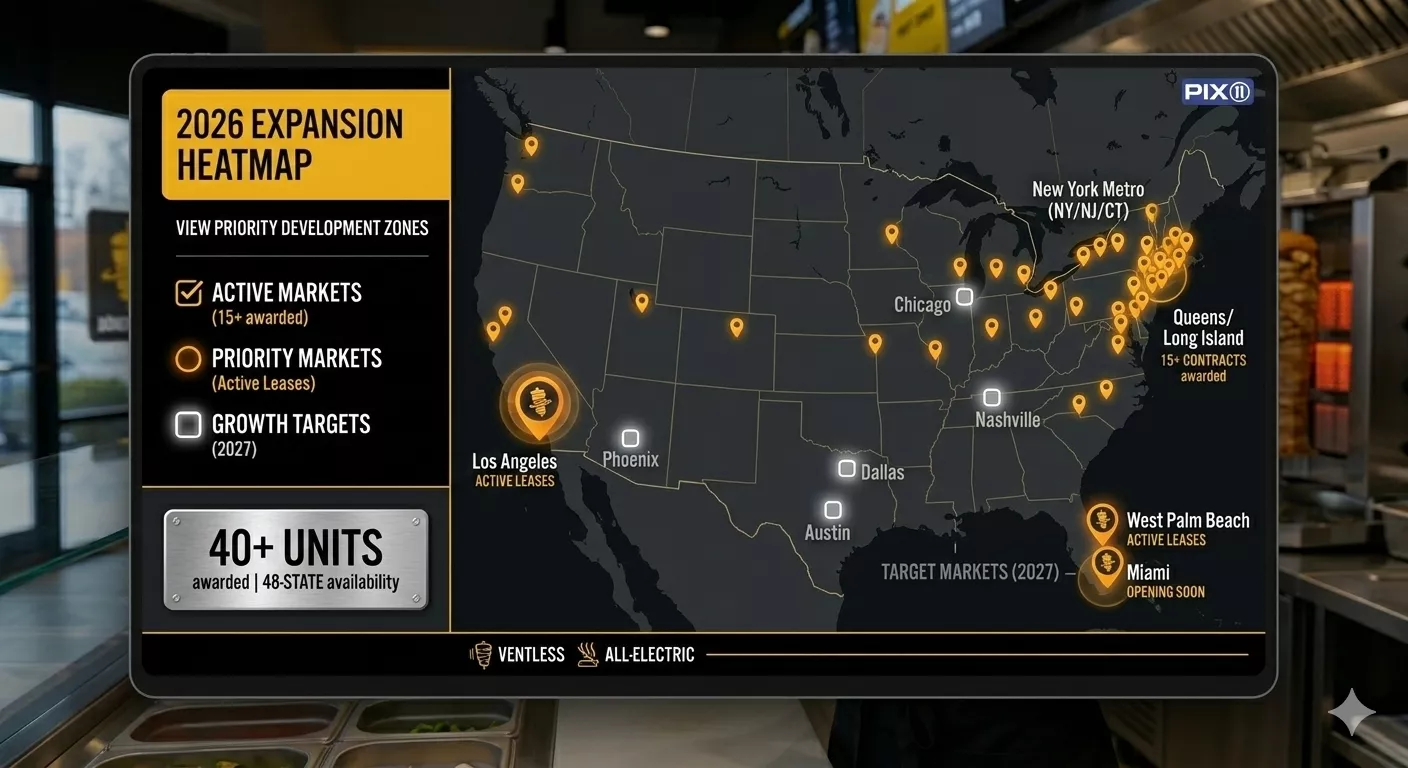
- Heatmaps filed as recruiting art.
What “as of” is doing in the league table
Item 20 counts close on a fiscal year-end. Filing dates are later. GDK’s 2024 FDD used here reports year-end 2023 counts; a 2025 Wisconsin effective date is a later document. The Halal Guys’ 93 units are as of 2024 in the comparative record; the Wisconsin page used as a public checkpoint is a 2025 filing. Döner Haus’s Item 20 is 4 as of 2025, inside a 2026 document; six shops are open now, with 7+ in construction and 55 commitments. Mixing those ending counts in a sentence without years is how a six-shop German döner and a 323-unit chain look like contemporaneous peers.
Founded dates are not Item 20. Wienerschnitzel founded 1961, franchising 1965, is a sixty-year operating story; 375° franchising since 2023 is not. Capriotti’s founded 1976, franchising 1991, sits in between. Use founding as context for Item 2 and Item 3, and use Item 20 for what happened to shops.
Crave’s 26 franchised of 26 (May 2024 comparative study) means there is no company-store laboratory in that count. bluTaco’s 33 franchised of 34 is almost the same shape. Mad for Chicken’s 2 franchised of 12 is the opposite shape. Franchisee-call programs look different in those three files even when the food is all “QSR.”
Dog Haus’s 58 franchised of 58, as of 2024, is a fully franchised count at that date. Transfers, if the tables show them, are the whole system’s ownership churn. There is no company row to absorb a failed shop unless a later reacquisition creates one.
The Great Greek’s 31 units as of 2023 and Crave’s 26 as of 2024 sit in the middle here: enough shops to call, not enough to treat any one state table as a law of large numbers. 375°’s 5 and Pepper Lunch’s 6 US units are the other side of that line. A single closing is a large percentage. That is information, not a moral. Döner Haus’s Item 20 of 4 as of 2025 is a compact filing snapshot: six shops open in three years, 7+ in construction, 55 commitments, none closed. Rebuild the three years, then call the list. The Halal Guys’ 93 as of 2024 and Dog Haus’s 58 as of 2024 are large enough that a convenience sample of three happy operators is statistically and practically inadequate. Use the lists. Projected openings in Item 20, when present, are still plans: compare them with the prior year’s actual openings before treating a development map as evidence.
Related reading
- Item 20 outlet tables — the tables and the Shah’s / Pepper Lunch worked cases
- Validation calls — how to sample the lists
- Item 1, the franchisor — narrative counts
- Item 19 — whether the FPR population matches the outlet population
- Red flags in franchise marketing — units wanted versus units opened
| Brand | Units | Franchised | Company | As of | Founded |
|---|---|---|---|---|---|
| Wienerschnitzel | 323 | 246 | 77 | 2024 | 1961 |
| Capriotti's | 145 | 135 | 10 | 2024 | 1976 |
| The Halal Guys | 93 | 88 | 5 | 2024 | 1990 |
| Shah's Halal Food | 58 | 0 | 14 | 2023 | 2005 |
| Dog Haus | 58 | 58 | 0 | 2024 | 2010 |
| bluTaco | 34 | 33 | 1 | 2024 | 2017 |
| The Great Greek Mediterranean Grill | 31 | 24 | 7 | 2023 | 2017 |
| Crave Hot Dogs and BBQ | 26 | 26 | 0 | 2024 | 2018 |
| Atomic Wings | 20 | 20 | 0 | 2024 | 2006 |
| Mad for Chicken | 12 | 2 | 10 | 2024 | 2017 |
| Döner Haus | 6 open | 1 | 3 | 2026 | 2023 |
| Pepper Lunch | 6 | 6 | 0 | 2024 | 1994 |
| 375° Chicken 'n Fries | 5 | 2 | 3 | 2023 | — |
| German Doner Kebab | 5 open | 7 | 0 | 2026 | 2017 |