11
Emerging food categories
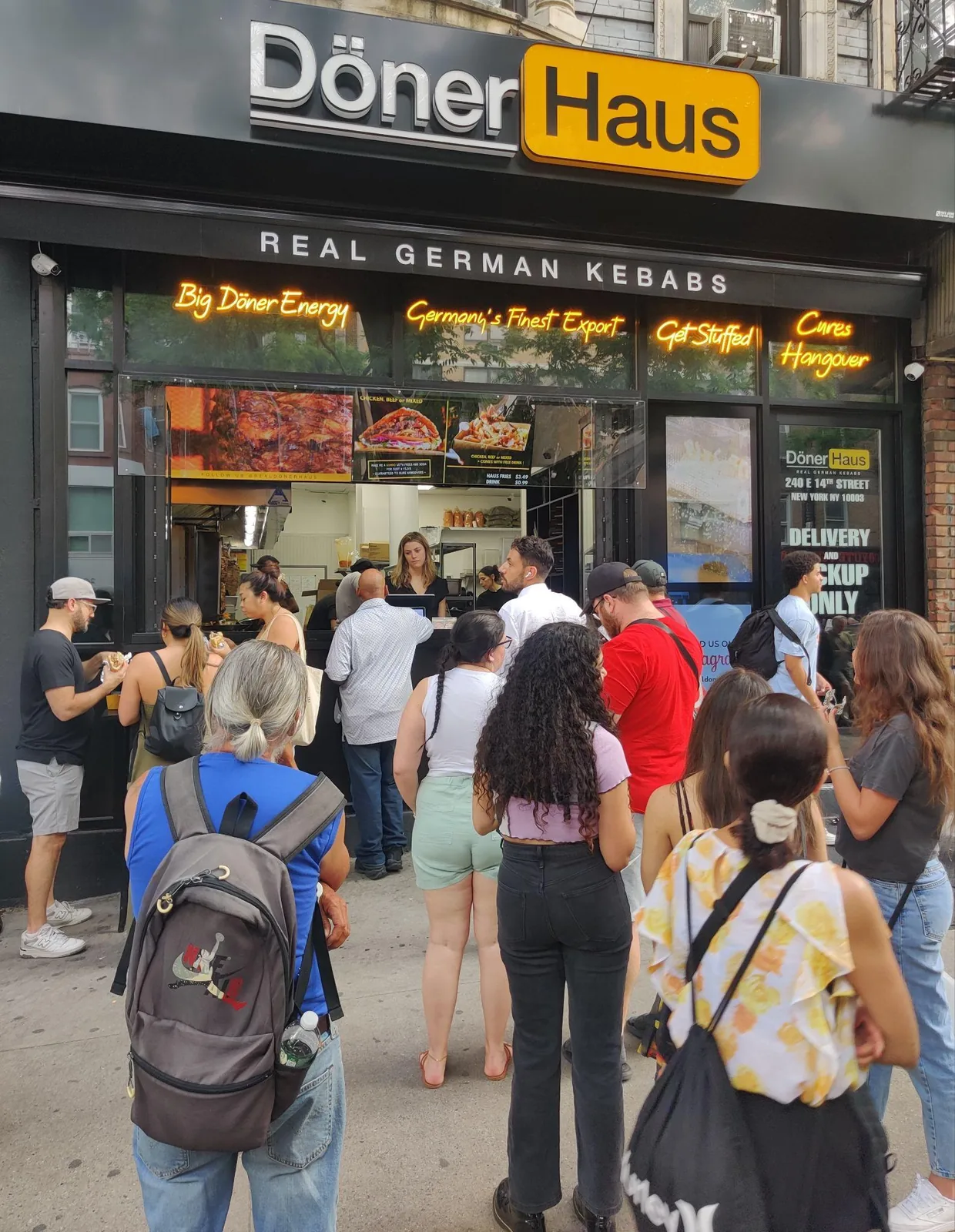
A category can be real and still have the wrong box. German döner in the US is Döner Haus's compact shop, not GDK's 1,400 sq ft restaurant.
“Emerging category” can describe a real change in customer awareness, and it can be a sales phrase with no defined denominator. You do not need to settle whether a cuisine is fashionable. You need to test whether this system has an operating history, a repeatable format and a support structure that justify the contract being offered.
German döner illustrates the distinction. Döner Haus’s 2026 filing is an 850–1,200-square-foot imbiss: the Berlin sandwich as a compact shop. GDK’s current franchise page describes an emerging fast-casual position and several store formats. Its 2025 Wisconsin filing supplies the disclosure against which those claims should be read: 1,200–1,400 square feet, a five-outlet minimum, an 11% stack, and six loss years at the US company. Street listings for Sugar Land, Bay Ridge, Westfield and Brighton Beach already read permanently closed; the 2024 FDD itself recorded Columbus Park as closed. The fact that a named format is less common in one market does not determine rent, labor, food cost or customer frequency. A scarce category also does not excuse selling a restaurant twice the size of the sandwich shop the category actually is, or treating a locator as a survival record.
Use at least two adjacent examples. Korean fried chicken can be an emerging cuisine story while Mad for Chicken’s filing describes a full restaurant and a smaller express format. Pepper Lunch pairs a distinctive hot-plate service with a small disclosed US base and a much larger international claim. The Halal Guys presents a category with long local history and current multi-format development claims on its official franchise page. Different narratives—new cuisine, imported format, regional concept, international system—create different evidence questions.
The filing, not the deck
A TAM does not price a unit
A category gap can suggest a demand hypothesis. It does not establish the unit format, recurring obligations or survival of stores already opened. The filing provides the first tests.
Outlet counts
Opened, closed and transferred outlets, brand by year. A small system can be young, selective, stalled or churning; Item 20 helps separate those stories.
Ask for: Item 20
Fees
The percentage, fixed and event-driven charges applied to the sales the category pitch promises, including adjustment rights.
Ask for: Item 6, with the cap
Square footage
The offered store types, premises assumptions and investment rows—not the archetypal shop used in the category story.
Ask for: Item 7's footnotes
Test the claim in layers
Category evidence: What exactly is being counted—restaurants, retail sales, delivery orders or a broad cuisine market? Which geography and year? A global market-size estimate is weak evidence for one US trade area.
System evidence: How many comparable outlets operated for a full period? What opened, transferred or closed? Does Item 19 cover the format and market being sold? A viral post or queue can show attention, not repeat visits or unit economics.
Unit evidence: What does Item 7 assume for premises and capital? Which hours and channels drive staffing? What recurring fees and required purchases apply? An unfamiliar food can still be sold through a familiar restaurant cost structure.
Organization evidence: Can the franchisor support site approval, training, supply, marketing and field operations at the planned development pace? Read Item 11, Item 20 and Item 21 together. A pipeline adds obligations before it adds experienced operators.
Compare with mature categories
An emerging system should not be excused from ordinary restaurant diligence. Use mature operators to sharpen questions, not to claim identical economics. Five Guys’ official franchise page says prospects receive an FDD, planning tools and connections to current franchisees. Wendy’s format page shows how a mature operator distinguishes food-court, fuel-station, military-base and transportation-center units. Ask an emerging brand for the equivalent format definitions and support obligations in its own filing.
Competition can validate demand while raising occupancy and marketing costs; scarcity can create curiosity while requiring customer education. Neither condition tells you whether the franchise agreement allocates risk fairly.
Write an investment thesis in falsifiable terms: target customer, occasion, comparable alternatives, proposed format and evidence needed before signing. Then list which claims come from the franchisor, which come from the FDD, which come from independent local research and which remain assumptions. The phrase “emerging category” belongs in the first column, not in the conclusion.
Döner, halal, chicken: three “new” stories, three filings
German döner in the US is still scarce in the filings, and the locators already disagree with those filings. GDK’s FDD issued 3 September 2024: 7 US units at year-end 2023, $690,500–$1,123,000 Item 7, 1,200–1,400 square feet, five-outlet minimum, Item 19 from one mall unit — and five later US shops closed. Döner Haus’s 2026 FDD: Item 20 of 4 as of 2025, $359,500–$586,000, 850–1,200 square-foot standing imbiss, 3% royalty and 2% brand fund — and six shops open in three years as of August 2026, seven or more in construction, 55 franchise commitments, none closed. Doner Shack’s FDD issued 29 April 2025: $498,000–$1,007,000, 1,200–1,800 square feet, 6% royalty, and zero US outlets in 2022, 2023 and 2024 against three affiliate restaurants in the United Kingdom. A category gap does not tell you which of those three is a restaurant you can staff. It does not excuse treating 1,200–1,400 square feet as a street cart.
Halal platter concepts can be described as emerging in some metros and as twenty-year incumbents in others. Shah’s, FDD issued 10 April 2024: 2005 founding, 58 shops, 0 franchised, 44 licensed, no Item 19. The Halal Guys, May 2024 comparative study: 1990 founding, franchising since 2014, 93 units, $60,000 fee, no Item 19 in that source. The cuisine name does not decide those contract terms.
Korean fried chicken is a cuisine story with a full-size box. Mad for Chicken, FDD issued 12 March 2025: 2,000–4,000 square feet, $321,125–$691,700, plus an express range, 12 units (10 company / 2 franchised), revenue-only Item 19. Pepper Lunch, May 2024 comparative study: teppan format, 6 US units, operator site claiming 500+ internationally, Item 7 $609,200–$1,471,500. An imported service ritual does not fill US Item 20.
| Claim type | What would falsify it |
|---|---|
| “No one does this food here” | Independent count of nearby substitutes (including delivery-only) |
| “The TAM is huge” | A TAM that is not the trade area and year of the proposed site |
| “The box is small” | Item 7 square feet and construction rows |
| “The system is proven overseas” | US Item 20 and US Item 19, read separately |
| “Franchisees are lining up” | Openings and transfers in Item 20, not a heatmap |
Category story, then the filing
- Define the food, the occasion, and the actual substitutes.
- Read Item 20 before the deck’s white space.
- Match format (imbiss, inline, express, teppan) to Item 7.
- Keep overseas counts out of the US unit cell.
- Write the thesis so a closed store would count as contrary evidence.
Scarcity does not cut the rent
A cuisine with few branded competitors can still bid against every other user of 1,200–2,000 square feet of inline retail. GDK’s $690,500–$1,123,000 and Shah’s $197,000–$405,000 (dated FDDs above) are both “emerging” relative to burgers in some markets and are not the same occupancy. Great Greek’s $582,014–$1,088,560 at 1,800–2,000 square feet is a seated Greek box competing with every fast-casual lease on the same strip. Category novelty does not appear in the landlord’s work letter.
375° Chicken ‘n Fries, FDD issued 30 April 2024: franchising since 2023, 5 units, $324,100–$521,500, 800–1,500 square feet, an affiliate Item 19. That is an emerging system, which is a different claim from an emerging cuisine. Chicken and fries are already common; the brand is young. Diligence should follow 375°’s Item 20 and Item 21 rather than a TAM slide about poultry.
Mad for Chicken’s express format at $243,500–$470,700 versus the full $321,125–$691,700 (FDD issued 12 March 2025) is how a category story splits into two boxes. If the deck shows the full dining room and the application is for express, the emerging-category pitch has already changed format. Use two worksheets.
The blue-ocean chart on the red flags page is Döner Haus’s map of the US QSR field. German döner can be scarce in a metro and still two different rooms: Döner Haus’s 850-to-1,200-square-foot imbiss with a 3% royalty, six shops in three years and 55 commitments, or GDK’s 1,200-to-1,400-square-foot restaurant with a 6% royalty, a five-outlet minimum, and shops that have since closed. The format picks the stack. A buyer who wants the sandwich window is in the first packet.
Related reading
- QSR vs fast casual — the box under the cuisine label
- System size — small US bases and international websites
- Item 19 — whether anyone has disclosed results in this country
- Red flags in franchise marketing — GDK’s shop count, Shah’s licensed map, uncapped fees
- Item 1, the franchisor — US entity versus overseas parent